
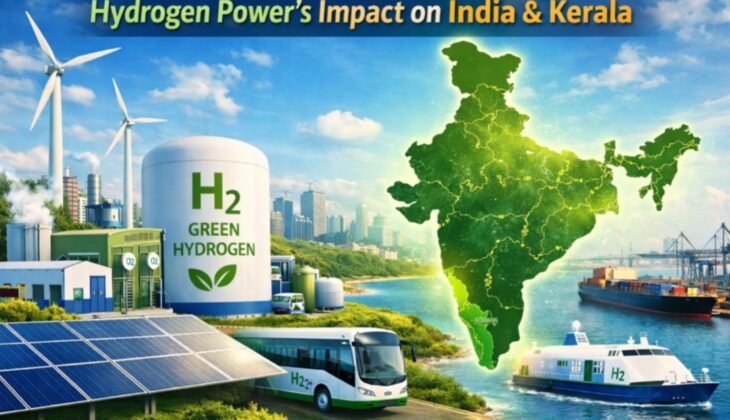
The Future of Green Energy: Hydrogen Power’s Impact on India and Kerala
As India moves toward a sustainable, carbon-neutral future, green hydrogen has emerged as the most promising renewable energy frontier. The National Green Hydrogen Mission is in full swing, positioning the country as a global hub for clean fuel production and export.
‘Hydrogen Economy’ has a transformative potential for both the industrial and domestic sectors in Kerala, a state already known for environmental consciousness and renewable adoption.
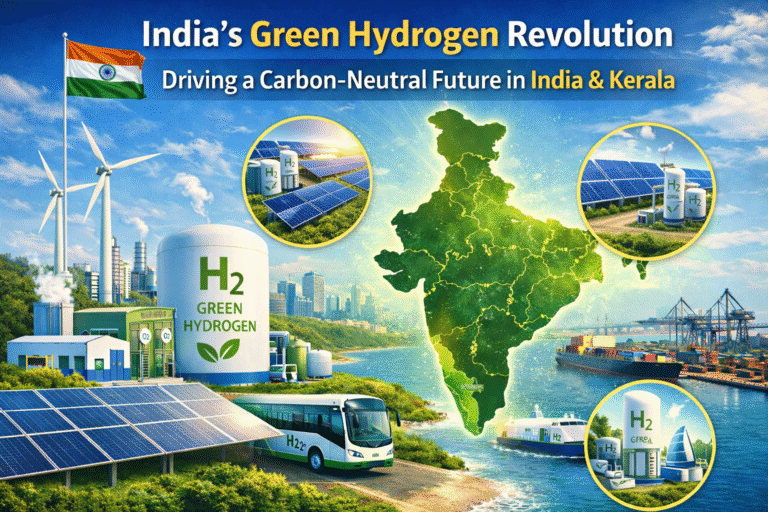
What is Green Hydrogen in the National Green Hydrogen Mission?
Using solar or wind energy, green hydrogen is produced through electrolysis, which splits water into hydrogen and oxygen. The combustion of hydrogen or the use of fuel cells produces only water vapor, which makes hydrogen a 100% clean fuel source.
India’s Vision: The National Green Hydrogen Mission
As part of its ambitious targets, the Indian government aims to reach net-zero emissions by 2070. In order to achieve this goal, 5 million metric tons of Green Hydrogen must be produced annually by 2030. Among the objectives of this initiative are:
*Streamline the import of petroleum and natural gas to reduce dependence on fossil fuels.
*Providing clean energy to steel, fertilizer, and long-haul shipping to decarbonize heavy industry.
*The storage of excess solar and wind energy for use during peak hours is referred to as energy storage.
Learn more from the official Ministry of New and Renewable Energy.
Kerala: A hub for green hydrogen
With its abundant water resources, extensive coastline, and proactive state policies, Kerala is uniquely positioned to benefit from the hydrogen revolution.
- Hydrogen Valleys and Clusters
“Hydrogen Valleys” have been proposed for Kochi and Thiruvananthapuram by the state government. Clusters like these will integrate production, storage, and consumption in a localized ecosystem. With its international port and refinery infrastructure, Kochi is well suited to become a gateway for hydrogen-powered shipping and logistics.
- Revolutionizing transport.
Public transport in Kerala, including KSRTC and water metro, is undergoing a transformation. Unlike battery-electric vehicles, hydrogen fuel cell buses and boats are able to travel longer distances and refuel faster, which makes them ideal for the state’s unique terrain.
- Solar Synergy
Hydrogen’s growth is inextricably linked to solar energy’s growth. It is necessary to use a huge amount of renewable energy in order to produce “green” hydrogen. As a result, large-scale on-grid solar installations across the state are required to power the electrolyzers.
Impact on the Future: Why It Matters
- *There will be new job creation opportunities as a result of this shift, ranging from high-tech chemical engineering to solar infrastructure maintenance and hydrogen safety auditing.
- *Independent from global oil prices: Kerala is able to insulate its economy against global oil price fluctuations by producing fuel locally.
- *As climate change worsens, Kerala’s Western Ghats and coastal ecosystems will be more vulnerable to damage from carbon emissions.
Conclusion
There is no longer a distant dream of hydrogen power-it is a reality that is unfolding all around us. Kerala is poised to show how a green economy can thrive as India expands its capacity.
We at Bodhie Solar believe that solar technology and hydrogen storage will be the backbone of a resilient energy future. For Kerala’s future, we are investing in renewable infrastructure to make the state cleaner, brighter, and more sustainable.
The National Green Hydrogen Mission will play a crucial role in shaping a sustainable energy future in India and Kerala.
Leave A Comment